
An inefficient kitchen appliance may not seem like a major expense on its own, but electricity use can add up over time. If you use your microwave several times a day, choosing an energy efficient microwave can be a practical way to reduce unnecessary electricity consumption.
But what actually makes a microwave energy efficient? Is a 700-watt microwave always more efficient than a 1,000-watt model? And which are the most energy efficient microwaves available today?
The answer is a little more complicated than simply looking at the wattage printed on the front of the microwave.
If you’re looking for the best energy efficient microwave, best energy saving microwave, or a microwave with ECO mode, here are five current options to consider.
5 Best Energy Efficient Microwaves Reviews
These picks cover different budgets, sizes, and kitchen setups. Rather than assuming that the microwave with the lowest wattage is automatically the most efficient, we considered how the appliance’s power, size, controls, and energy-saving features work together.
1. Chefman 0.7 Cu. Ft. 700-Watt Countertop Microwave
Best compact energy-saving microwave
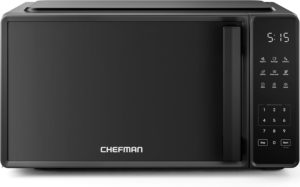
If you need an energy efficient microwave for a small kitchen, the Chefman 0.7-cu.-ft. countertop microwave is an appealing option. It uses 700 watts of cooking power and includes an Eco Mode that shuts off the LED display when the microwave is not being used. Walmart currently lists the model with 10 power levels, six preset programs, a memory function, a +30-second button, and a child safety lock.
The compact size is another reason it makes sense for energy-conscious shoppers. If you primarily reheat leftovers, warm beverages, cook frozen meals, or make simple snacks, you may not need a large 1.5- or 2.0-cu.-ft. microwave.
Its 700-watt cooking power also makes it suitable for people who don’t need extremely fast cooking. Keep in mind, however, that cooking wattage describes the microwave’s output power; it should not be treated as a complete measure of the appliance’s electricity consumption.
The Eco Mode is particularly useful because it addresses standby power. Instead of keeping the display illuminated when the microwave is sitting unused, the energy-saving mode turns the display off.
Key features:
- 0.7 cu. ft. capacity
- 700 watts
- 10 power levels
- Eco Mode
- Six preset cooking programs
- Memory function
- +30-second quick start
- Child safety lock
2. Galanz 1.1 Cu. Ft. 1000-Watt Countertop Microwave
Best energy-saving microwave for everyday use
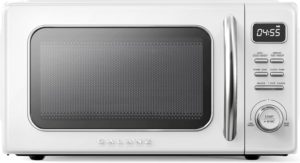
For shoppers who want more interior space without moving to a large family-size microwave, the Galanz 1.1-cu.-ft. countertop model is worth considering.
Walmart currently lists this Galanz microwave with 1,000 watts of cooking power, 10 power levels, six preset cooking options, weight and time defrost, and an Eco Energy Saver Mode. The model also includes a 12-inch turntable and a push-open door.
The Eco Energy Saver Mode is one of its most useful features for anyone specifically searching for an energy-saving microwave oven. The appliance can reduce unnecessary power use when it is not actively cooking.
The 1.1-cu.-ft. capacity also gives you more flexibility than a tiny 0.7-cu.-ft. model. It can accommodate larger plates and is better suited to everyday family cooking.
Another advantage is the relatively straightforward control panel. You get useful functions without having to navigate an overly complicated smart interface.
Key features:
- 1.1 cu. ft. capacity
- 1,000 watts
- 10 power levels
- Eco Energy Saver Mode
- Six preset cooking programs
- Weight and time defrost
- 12-inch turntable
- Mute function
3. Toshiba ML-EC42P(BS) 4-in-1 Countertop Microwave
Best energy-saving microwave for a larger household
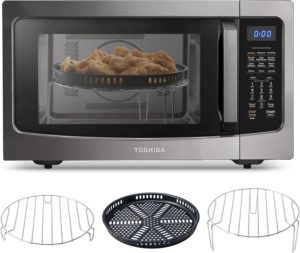
If you want an energy efficient microwave with more cooking functions, the Toshiba ML-EC42P(BS) is a very different proposition from a basic 700-watt countertop model.
This 1.5-cu.-ft. microwave has 1,000 watts of microwave cooking power and combines microwave cooking with convection and air-frying functions. Walmart currently lists the model with an ECO mode and LED cavity light designed to reduce energy consumption.
The larger 1.5-cu.-ft. capacity makes it a better fit for families or anyone who regularly heats large plates, casseroles, or other sizeable portions. It also has a 13.6-inch turntable.
Another useful feature is the smart sensor. The microwave can use preset sensor programs for foods such as potatoes and vegetables, which can help avoid unnecessarily long cooking times.
Of course, this is not the cheapest option on the list. Its appeal comes from combining a relatively large microwave with several cooking functions in one appliance. If you would otherwise purchase a microwave, toaster oven, and air fryer separately, a multifunctional model may also help reduce the number of appliances occupying your kitchen.
Key features:
- 1.5 cu. ft. capacity
- 1,000 watts
- ECO mode
- LED cavity light
- Air fry function
- Convection cooking
- Smart sensor cooking
- 13.6-inch turntable
4. Samsung ME16K3000AW 1.6 Cu. Ft. Over-the-Range Microwave
Best energy-saving over-the-range microwave
If you need an energy efficient over-the-range microwave, the Samsung ME16K3000AW is another option to consider.
Home Depot currently lists this 1.6-cu.-ft. Samsung over-the-range microwave and specifically identifies Eco Mode among its features. The microwave also has a 300 CFM ventilation system, LED display, and cooking presets.
Eco Mode is useful because a microwave can consume some electricity even when it is not actively heating food. On this Samsung model, the power-saving feature can turn off the display when the microwave is not being used.
The 1.6-cu.-ft. capacity is considerably larger than the compact countertop models above, making this a more appropriate choice for a family kitchen.
Another advantage is that an over-the-range microwave combines two kitchen functions: microwave cooking and range ventilation. This can be useful if you’re replacing an existing over-the-range unit and want an energy-conscious model without sacrificing cabinet and counter space.
Key features:
- 1.6 cu. ft. capacity
- 1,000 watts
- Eco Mode
- 300 CFM ventilation
- LED display
- Cooking presets
- Over-the-range installation
5. Galanz 1.7 Cu. Ft. Over-the-Range Microwave
Best large energy-saving microwave
For a larger household, the Galanz 1.7-cu.-ft. over-the-range microwave offers plenty of interior space while still including an energy-saving mode.
Walmart currently lists this model with 1,000 watts of cooking power, 11 variable power levels, a 1.7-cu.-ft. capacity, and an ECO mode. It also includes nine auto-cook programs and a two-speed exhaust fan.
The large 1.7-cu.-ft. interior can accommodate everything from everyday dinner plates to larger casseroles. A 12.4-inch glass turntable helps make use of the available interior space.
The ECO mode is the main reason this model belongs on a list of energy-saving microwaves. It is designed to reduce unnecessary electricity use while the microwave is idle.
Because it is an over-the-range model, installation is more involved than with a countertop microwave. You’ll also want to consider the ventilation requirements and make sure the dimensions match your existing cabinet and range setup.
Key features:
- 1.7 cu. ft. capacity
- 1,000 watts
- 11 power levels
- ECO mode
- Nine auto-cook programs
- 12.4-inch turntable
- Two-speed exhaust fan
- Over-the-range design
What Makes a Microwave Energy Efficient?
There is no single specification that tells you whether a microwave is the most energy efficient microwave. Instead, look at several factors together.
1. ECO or Energy-Saving Mode
An ECO mode microwave is worth considering if you want to reduce standby electricity use. These modes commonly turn off the display or otherwise reduce the microwave’s power consumption while it is idle.
For example, current Chefman models advertise Eco Mode that disables the display when the microwave is not in use, while Toshiba and Galanz models also advertise ECO or Eco Energy Saver features.
2. Appropriate Cooking Power
Wattage needs a little explanation. A microwave advertised as 700 watts generally produces less microwave cooking power than a 1,000-watt model, but that does not automatically mean it uses less electricity for every cooking task.
A higher-powered microwave may cook food faster, while a lower-powered microwave may take longer. What matters is how much electricity the appliance uses for the actual cooking task, rather than looking at the wattage number alone.
For this reason, don’t automatically choose the lowest-wattage microwave simply because you’re searching for an energy efficient microwave.
3. The Right Size for Your Needs
Size matters because there is little reason to buy a huge microwave if you only heat a coffee mug or a single dinner plate.
A compact 0.7-cu.-ft. microwave can make sense for a dorm room, office, studio apartment, or small household. A larger 1.5- or 1.7-cu.-ft. model makes more sense if you regularly cook large portions.
The best approach is to choose a microwave that is large enough for your typical dishes but not significantly larger than you need.
4. Sensor Cooking
Sensor cooking can also contribute to efficient everyday use. Instead of manually guessing how long food needs to cook, the microwave uses sensors to determine when the food has been heated sufficiently on supported programs.
This can help reduce the chance of unnecessarily long cooking cycles.
5. LED Lighting
Some newer microwaves use LED interior lighting rather than older-style bulbs. LED lighting generally requires less electricity and lasts longer, although the lighting itself is only a small part of a microwave’s total energy use.
Does a Lower-Wattage Microwave Use Less Electricity?
Not necessarily.
This is one of the most common misconceptions about energy efficient microwaves. A microwave’s advertised wattage normally refers to cooking output, not necessarily the exact amount of electricity drawn from the wall.
A 700-watt microwave may require more time to heat the same food than a 1,000-watt microwave. Therefore, simply comparing “700W” and “1,000W” does not tell you which appliance will always use less electricity.
Instead, consider the microwave’s cooking performance, standby-power features, size, and how you actually use it.
How to Save Electricity When Using a Microwave
Buying an energy-saving microwave oven is only part of the equation. Your cooking habits can also make a difference.
- Use the correct cooking time: Avoid running the microwave longer than necessary.
- Use sensor cooking when appropriate: Let the microwave determine cooking time for compatible foods.
- Use ECO mode: Turn on the power-saving mode when you don’t need the display or clock.
- Don’t repeatedly open the door: Interrupting cooking can make it harder to heat food efficiently.
- Choose the right size: Don’t buy a large microwave if a compact model meets your needs.
- Clean the microwave regularly: Keeping the cavity and vents clean helps the appliance operate properly.
- Cover food appropriately: Properly covered food can heat more evenly and reduce splattering.
Are Microwaves Energy Efficient Compared With Ovens?
For many small cooking and reheating jobs, a microwave can be a practical alternative to heating a full-size conventional oven. A microwave heats food directly rather than heating a large oven cavity, so it can be particularly convenient for small portions.
However, the exact energy savings depend on the food, cooking method, appliance, cooking time, and how you use it. It is better to think of a microwave as an efficient tool for certain tasks rather than assuming every microwave is automatically more energy efficient in every situation.
Are There ENERGY STAR Microwaves?
At present, residential microwave ovens are not an ENERGY STAR-certified product category in the United States. The current ENERGY STAR product list includes categories such as refrigerators, dishwashers, clothes washers, dehumidifiers, and residential electric cooking products, but not standalone residential microwave ovens.
That means you should be careful when searching for an “ENERGY STAR microwave.” A retailer or article may use the phrase loosely, but it does not mean the microwave carries an ENERGY STAR certification.
Instead, look for concrete energy-saving features such as ECO mode, power-saving mode, efficient LED lighting, sensor cooking, and an appropriately sized cavity.
How Much Electricity Does a Microwave Use?
Electricity consumption depends on the microwave’s electrical input, cooking power, cooking time, and standby behavior.
For example, a microwave that runs for a short period each day may consume relatively little electricity compared with appliances that operate continuously. However, the microwave can still draw some power while sitting idle if its display and electronics remain active.
This is why standby power and ECO mode are worth considering if your goal is to minimize unnecessary electricity consumption.
Final Thoughts
The best energy efficient microwave isn’t necessarily the microwave with the lowest wattage. Instead, look for a model that matches your cooking needs while providing practical energy-saving features.
For a small kitchen, the 700-watt Chefman is a sensible compact option because it combines low cooking power with an Eco Mode that shuts off the display when the microwave isn’t in use. The Galanz 1.1-cu.-ft. model provides more interior space while retaining an Eco Energy Saver Mode.
For larger households, the Toshiba ML-EC42P(BS) adds a 1.5-cu.-ft. cavity, ECO mode, sensor cooking, convection, and air frying. If you need an over-the-range microwave, the Samsung ME16K3000AW and Galanz 1.7-cu.-ft. model provide larger capacities with energy-saving modes.
Ultimately, the smartest way to shop for an energy-saving microwave oven is to consider the whole picture: size, cooking power, standby power, ECO mode, sensor cooking, and how frequently you actually use the appliance.
Frequently Asked Questions
What is the most energy efficient microwave?
There is no single microwave that can be called the most energy efficient for every household. Compact models with appropriate cooking power and standby-power-saving features can be a practical choice, while larger models may be more appropriate when you regularly cook larger portions.
What is the best energy-saving microwave for a small kitchen?
A compact 0.7-cu.-ft. microwave such as the Chefman 700-watt model can be a good option for a dorm, office, apartment, or small kitchen. It has Eco Mode that turns off the display when the microwave is not being used.
Does microwave wattage affect energy consumption?
Yes, but wattage alone doesn’t tell you which microwave will use less electricity. A higher-wattage microwave may cook food faster, while a lower-wattage model may require more cooking time.
What is ECO mode on a microwave?
ECO mode is an energy-saving feature that reduces power consumption when the microwave is not actively cooking. Depending on the model, it may turn off the display or reduce standby power.
How can I make my microwave more energy efficient?
Use the correct cooking time, avoid unnecessarily long cooking cycles, choose the right microwave size for your needs, use sensor programs when appropriate, and activate ECO or power-saving mode when available.
Are 700-watt microwaves more energy efficient?
Not automatically. A 700-watt microwave has lower cooking output than a 1,000-watt model, but it may need more time to heat the same food. Compare the entire appliance and your actual usage rather than wattage alone.